






 Lobby
 Roobet Games
 Slots
 Live Casino
 Game Shows
 Popular Games














Roobet Originals
Roobet Originals are the platform’s own collection of quick casino games. Instead of following the reels and bonus features of a conventional slot, you might choose a dice range, reveal a tile, drop a Plinko ball or decide when to leave a rising multiplier. The controls are straightforward, but each format creates a different balance between hit frequency and potential return.
Compare the Originals by their rules, betting limits and payout structure. Each game has its own settings and profit ceiling, with fairness tools available for checking supported rounds.
The Originals collection forms a distinct part of Roobet, with its own rules and verification controls.

What Makes an Original Different?
The defining feature is the direct connection between a choice and its displayed payout. Dice lets you adjust a winning range; Mines changes as safe tiles are uncovered; Crash asks you to cash out before the round ends. More demanding outcomes generally offer larger multipliers because they happen less often.
Provably fair verification provides a way to check supported rounds using the game’s seed and verification tools. It is a check on a recorded outcome, not a preview of the next result. Before placing a bet, open the rules and fairness panel for the specific game because the verification procedure can differ between Originals.
Minimum Bets and Maximum Profit in Roobet Originals
Compare minimum stakes, maximum bets and profit caps across nine Roobet Originals. The maximum profit is the upper limit for a game, rather than the amount available from every stake or setting. Current limits and the selected currency are displayed in the betting panel.
| Game | How the round works | Minimum bet | Maximum bet | Maximum profit |
|---|---|---|---|---|
| Crash | Cash out before the multiplier stops | $0.01 | $20,000 | $1,000,000 |
| Keno | Choose numbers and match the draw | $0.01 | $20,000 | $3,000,000 |
| Mission Uncrossable | Cross lanes and cash out before a collision | $0.01 | $20,000 | $3,000,000 |
| Mines | Reveal safe tiles while avoiding hidden mines | $0.01 | $20,000 | $3,000,000 |
| Dice | Choose the range that must contain the result | $0.01 | $20,000 | $3,000,000 |
| Plinko | Drop a ball into a payout pocket | $0.01 | $10,000 | $500,000 |
| Roulette | Bet on the colour or symbol reached by the wheel | $0.01 | $20,000 | $3,000,000 |
| Towers | Pick safe positions while climbing the board | $0.01 | $20,000 | $3,000,000 |
| Coin Flip | Choose a side for a coin-flip match | $0.01 | $200,000 | $384,000 |
Understanding a Maximum Win
A multiplier and a cash ceiling describe different things. For example, settling a $2 bet at 5× returns $10 in total. After the original $2 is deducted, the profit is $8, provided no payout restriction applies. The maximum profit cap limits net winnings; it is separate from the payout multiplier and does not guarantee a winning result.
For any particular round, check the stake, payout schedule and profit or payout cap together. Changing a difficulty setting can alter the distribution of results without changing the headline ceiling.
Choose a Game by Its Mechanics
| Style | Games | Main decision | What to check |
|---|---|---|---|
| Cash-out rounds | Crash, Mission Uncrossable, Towers | Whether to take the current result or continue | Cash-out rules and the consequence of a failed step |
| Number and range games | Keno, Dice | How narrow or difficult the winning selection should be | Win probability and the corresponding payout |
| Tile selection | Mines | Board size, mine count and when to stop | Safe tiles remaining and the next-step multiplier |
| Ball and wheel games | Plinko, Roulette | Risk setting or the outcome to back | Payout schedule, losing outcomes and special rules |
| Two-sided matches | Coin Flip | Side and stake for each match | Match count and how much is committed in total |
When to Cash Out in Crash
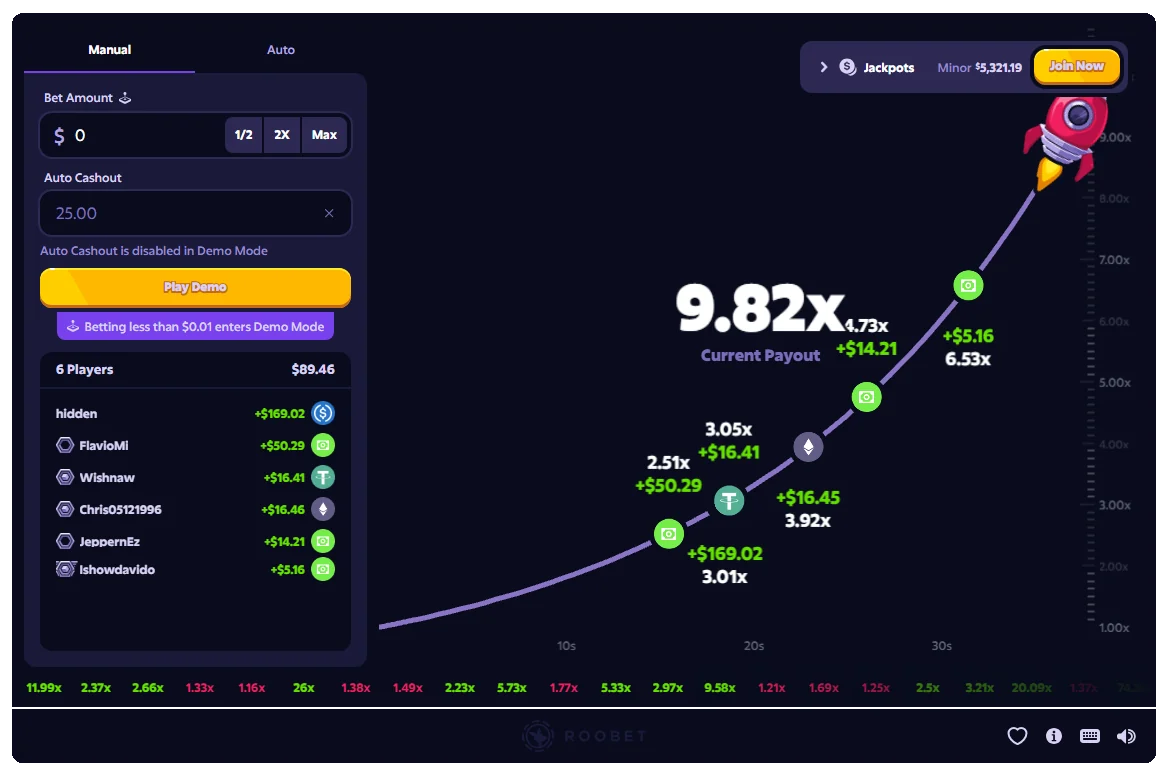
Crash begins with a rising multiplier and ends when the round crashes. A successful cash-out locks in the multiplier reached at that moment; a crash before cash-out loses the wager. Where automatic cash-out is available, a target can be set before the round begins.
The recent-results strip is a record of earlier rounds. A run of low crashes does not make a high result due, and a green result does not establish a pattern for the next launch. Earlier cash-out targets can reduce the return sought on a successful round, but they cannot remove the possibility of a loss.
Understanding Probability in Keno and Dice
Keno uses a numbered board from 1 to 40. You select between one and ten numbers, then compare your picks with the draw. The number of selections and the chosen risk setting determine which matches receive a payout. Read the whole paytable: a larger top prize may come with more losing combinations.
Dice turns probability into a range selection. Depending on the available controls, you can back a result under a threshold, over it, between two values or outside a range. A two-range option allows a selection across two separate intervals. Narrower winning selections generally pay more when successful because fewer results qualify.
Betting progressions such as Martingale or D’Alembert do not change the probability of the next roll. Increasing stakes after losses can rapidly increase the amount at risk, especially when a balance or betting limit interrupts the progression.
Mines, Towers and Mission Uncrossable
These games share a stop-or-continue structure. You can take an available return after a successful step, or pursue a larger multiplier while exposing the wager to a fresh possibility of failure. Continuing is a new risk decision rather than a free extension of an earlier win.
- In Mines, reveal tiles on a board containing hidden mines. Choose a board of 25, 36, 49 or 64 tiles and a mine count from one up to one fewer than the total tiles. The payout depends on the configuration and the safe selections already made.
- In Towers, choose safe positions as you move upwards. Difficulty settings run from Easy through Medium, Hard and Expert to Crazy. A failed selection ends the round; a successful step creates another opportunity to cash out.
- In Mission Uncrossable, guide the chicken across successive traffic lanes. Easy, Medium, Hard and Daredevil settings change the balance between survival probability and payout. Check the active rules for the actual probability at each step rather than treating the lane animation as a signal.
Rows and Payout Pockets in Plinko
A Plinko ball travels through a field of pegs into a pocket with a displayed multiplier. Choose eight to sixteen rows and explore Low, Medium, High or Lightning modes. A result below 1× returns less than the wager; 0× returns nothing.
Depending on the selected board, top multipliers can reach 16× in Low, 110× in Medium and 1,000× in High mode. Lightning introduces extra features along the path and losing zones. These are setting-dependent examples, so the paytable shown for the selected board takes priority. A faster animation changes how quickly the result appears, not the underlying odds.
Roulette and Coin Flip
Roobet’s Original Roulette is a simplified symbol-and-colour game, rather than a standard numbered roulette layout. The payout schedule includes 2× for red or black diamond-and-star selections, 7× for a red-and-black star selection and 14× for the green Roo symbol. Read the game’s own payout labels before comparing those returns with another roulette variant.
Its Triple Roo Jackpot is associated with three consecutive green Roo outcomes. Qualification depends on the promotion’s betting and allocation rules; landing a green result alone should not be treated as an automatic entitlement to a jackpot share.
Coin Flip reduces the choice to two sides: a Roo logo or a hat. Choose a single match or a batch of two, five or ten matches. If the same stake is applied to each match, a batch commits that stake multiple times. Check both the per-match amount and the total before starting a player or bot match.

How to Open an Original
- Open the account menu and use your existing sign-in method, or follow the registration prompts if you are eligible to create an account.
- Go to the Roobet Games category and choose a title.
- Read its rules, paytable, current limits and fairness information.
- Use a demo option where one is explicitly available before deciding whether to play with a balance.
- For a funded session, use the cashier to select an accepted asset and follow the transfer requirements for its network.
- Set the stake and any risk controls, then check the total amount committed before starting.
Visit Login for help entering your account. The Casino section covers the wider catalogue, while Promotions and VIP Club describe the site’s reward sections.
Demo Play, Mobile Access and Rewards
Demo availability varies. A practice mode, when offered, uses virtual value and cannot produce a withdrawable win. Look for the game’s actual demo control. Do not assume that entering a stake below the stated minimum will safely switch a real-money game into practice mode.
Mobile play uses the browser. The core decisions remain the same on a phone: choose the game settings, confirm the stake and follow the result. Before a cash-out game, make sure its controls are clear on the screen and avoid relying on a connection that repeatedly drops.
Rewards have separate conditions. Eligible play may contribute to loyalty progress or rakeback, subject to the current rules. VIP access is not an automatic consequence of opening an account. Rewards do not change a round’s probability and should not be added to a payout estimate unless their eligibility and value are known.
A Practical Way to Compare the Games
- Start with the paytable, not the largest prize in the headline. Identify which results return less than the stake and which return nothing.
- Compare settings at the same stake. A higher multiplier usually accompanies a less frequent successful outcome.
- Treat each additional tile, lane, match or automatic round as additional exposure.
- Choose a spending limit before starting and stop when it is reached. Trying to recover a loss by increasing the next stake does not improve the odds.
- Use the fairness tools to check supported completed rounds, and the game rules to resolve questions about caps or settlement.